

- You are here :
Do you know your family history
- Published on : 14-03-22
- Category :
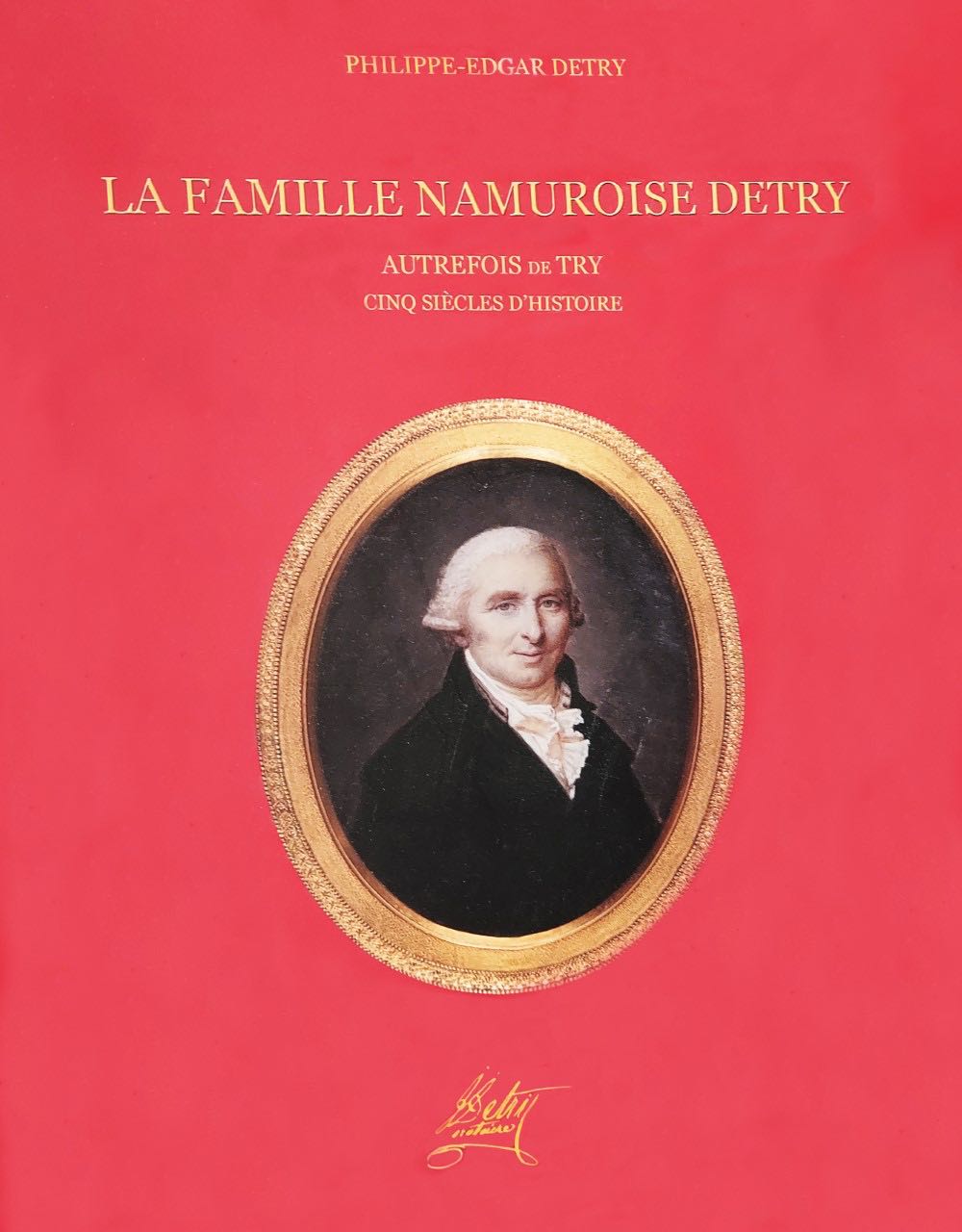
Interview with Philippe-Edgar Detry, author of the book "la famille namuroise Detry" cinq siècles d'histoire. A genealogical adventure.
Hello Philippe-Edgar
You've written a very impressive 816-page book containing a wealth of information about your family.
When and how did you begin your work?
I became interested in history and genealogy when I was a teenager, thanks to my paternal grandmother, to whom I was close, who loved genealogy and with whom I spent months making an inventory of the archives kept in the family home: deeds, photos, portraits, letters, menus, pious souvenirs, genealogical sketches and so on. I recorded all this and then extended my research to public collections: the State Archives, the Royal Library, genealogy circles, Land Registry and Registration archives, the press, which was initially available in public places and has been available online for some years now, etc. I then consulted and interviewed all possible members of the family, consulted and reproduced their own archives and... scoured cemeteries photographing family vaults. The publication I did on my paternal family dates back to 2015, when I was 53 years old, and represented 25 years of research interrupted by a marriage, three children and a professional activity. In fact, since the age of 27, I have published around thirty genealogical publications on one or other of my family's ancestors, because as you know, Sophie, we all have many and varied ancestral neighbourhoods.
Since 2015, I've published my mother's genealogy and I'm currently working on a great-grandmother's. When you're hooked...
What was your desire, your objective?
To get to know my roots in every possible way, and to protect, through publications, documents that don't always fascinate the family, who wrongly consider them to be of little interest, and which, although they have no great market value, are often the first to disappear when a family moves house or is inherited, an irreparable loss because private archives and memories are never found when consulting public collections... But beyond the names and dates, there is a desire on my part to retrace the lives of these family characters in their own history and in their own time. It's fascinating and deeply moving.
We are a link in a chain and everything positive or negative in our roots makes up who we are.
What tools did you use to carry out this research, and how did you go about it?
The main rule is to start from the known and work your way up through public sources such as civil records and parish registers to establish a reliable ancestry. Family notes and oral recollections should not be taken at face value; they may be true, but they can also be completely far-fetched.
In past centuries, many genealogies were built from scratch because they were a tool for social advancement.
You have to be circumspect, curious, sometimes have an intuition that turns out to be true... or not, and above all not have a positive or negative preconception. "modest' and, conversely, today belong to a social class that is considered 'inferior' and have origins that are sometimes... "prestigious' origins. The wheel turns within families and those who counted yesterday may no longer be in that situation and vice versa.
But we have so many ancestors that, as the old saying goes, 'we're all descended from a baron and a hanged man'! I've found this to be true in my own case!
How far back have you been able to trace your family?
My father's family goes all the way back to the 15th century, with even earlier traces, and my mother's family goes all the way back to the Capets, who gave rise to the kings of France. Many Belgians, for example, are proven descendants of Charlemagne.
But some families have left more traces than others through the functions they performed, a small heritage passed on or simply through the public archives that have or have not been preserved. We know how many archives disappeared during bombings such as those in Namur, Tournai, Mons, Dinant, Louvain etc. The merging of communes has also led to irreversible losses in some communes. So there is a certain amount of luck involved...
How has your family reacted?
For the most part, very positively. Some of them were genuinely interested, and for those who were less concerned, seeing their family history recorded in a book that could be placed on the coffee table in the living room had a nice effect!
What were your greatest discoveries?
First and foremost, the human ones... Because as well as handling old documents, you make a lot of contacts, you find or rediscover a host of cousins and it's very enriching.
In terms of content, the lives of all these people - who have loved, cried, laughed and been shaken by life and events - have provided a wealth of information. In circumstances that are often different from our own, yet with so many similarities, because we are still human beings with a heart, a mind, courage or not, resilience or not.
And then there were these discoveries....an ancestor banished from the county of Namur on suspicion of disguising himself as a cleric to rob travellers... or a kinship established between two rather... different characters, and me: Johnny Hallyday and Jean d'Ormesson... moreover, yes Sophie, that's genealogy, cousins to each other! Who would have thought!
What were your greatest difficulties?
Sometimes convincing people to share leads, to lend documents, but also to open up to me. Because genealogy is a bit of an intrusion and sometimes brings up buried suffering, things that are left unsaid and even family secrets... It takes diplomacy and no doubt a lot of heart...
What will become of this book?
I hope to have taught and touched its readers. To have raised awareness about conservation. My book on the Detry family had a print run of 600 copies and I still have 5 to go... You can find them in many private homes and public places all over the world: in Argentina, France, Italy, England, the Netherlands, Spain etc...
A book is a bit of yourself that you pass on too!
Can anyone do genealogy? What advice would you give to those who might be tempted by the adventure?
Of course you can! First of all, you have to be patient and persistent. You also have to be prepared to devote a budget to research, and preferably to publication, which is the ultimate goal.
Then you have to gather together everything that might be of interest to your family, and leave no stone unturned. A simple written postcard could be a clue, a revelation of something, and then you have to talk to everyone close to you and get the elderly to talk. Then corroborate all this with public sources, which are increasingly available online.
You'll see that once you've had a taste of it, you'll always want to go further, and I can guarantee you emotions, discoveries, and that feeling filled with the richness of discovering those of whom our DNA is made up.
Happy research! Thank you Philippe-Edgar!
Sophie Mercier
